 Add to Chrome
 Add to Firefox
 Add to Edge
Enhancing LLM Metacognition via Cognitive Pairwise Training
May 30, 2026
Reinforcement learning with verifiable rewards (RLVR) has become central to LLM reasoning, but its outcome-level rewards can make models more willing to give confident answers when evidence or reasoning is unreliable. Existing SFT or RL methods mainly teach LLMs to refuse or express uncertainty at the response level, which can overfit abstention behavior rather than improve reasoning reliability. To address this limitation, we propose Cognitive Pairwise Training (CPT), a cognitive mid-training alignment stage that turns pairwise comparisons over reasoning traces into a reusable alignment signal. By learning to distinguish trustworthy from flawed reasoning, CPT encourages the model to internalize a reasoning-quality discrimination boundary rather than memorize surface refusal patterns. Across five model scales and three model families, CPT improves the reasoning--metacognition trade-off. At 14B, CPT+RL outperforms the standard SFT+RL pipeline by +2.2 math-average points and +5.2 abstention-F1 points. Further analyses show that CPT improves trace quality and exhibits strong robustness and scalability across evaluation and training settings. Code and models are released at https://github.com/Tsinghua-dhy/CPT.

The MiniMax-M2 Series: Mini Activations Unleashing Max Real-World Intelligence
May 26, 2026We introduce the MiniMax-M2 series, a family of Mixture-of-Experts language models built around the principle that mini activations can unleash maximum real-world intelligence. The flagship M2 contains 229.9B total parameters with only 9.8B activated per token. Designed end-to-end for agentic deployment, the M2 series rests on three components: (i) agent-driven data pipelines producing large-scale, verifiable trajectories across agentic coding and agentic cowork, each grounded in an executable workspace and an artifact-aligned reward; (ii) Forge, a scalable agent-native RL system that adapts to long-horizon agent trajectories, paired with windowed-FIFO scheduling, prefix-tree merging, inference optimization, and a clean training-inference-agent decoupling that supports both white-box and black-box agents; (iii) the latest M2.7 checkpoint takes an early step toward self-evolution -- autonomously debugging training runs and modifying its own scaffold. Across M2 through M2.7, this combination translates a mini-activation footprint into frontier-tier performance on agentic coding, deep search, office-task, and reasoning benchmarks.
Deep Research for Recommender Systems
Mar 08, 2026The technical foundations of recommender systems have progressed from collaborative filtering to complex neural models and, more recently, large language models. Despite these technological advances, deployed systems often underserve their users by simply presenting a list of items, leaving the burden of exploration, comparison, and synthesis entirely on the user. This paper argues that this traditional "tool-based" paradigm fundamentally limits user experience, as the system acts as a passive filter rather than an active assistant. To address this limitation, we propose a novel deep research paradigm for recommendation, which replaces conventional item lists with comprehensive, user-centric reports. We instantiate this paradigm through RecPilot, a multi-agent framework comprising two core components: a user trajectory simulation agent that autonomously explores the item space, and a self-evolving report generation agent that synthesizes the findings into a coherent, interpretable report tailored to support user decisions. This approach reframes recommendation as a proactive, agent-driven service. Extensive experiments on public datasets demonstrate that RecPilot not only achieves strong performance in modeling user behaviors but also generates highly persuasive reports that substantially reduce user effort in item evaluation, validating the potential of this new interaction paradigm.
RecNet: Self-Evolving Preference Propagation for Agentic Recommender Systems
Jan 29, 2026Agentic recommender systems leverage Large Language Models (LLMs) to model complex user behaviors and support personalized decision-making. However, existing methods primarily model preference changes based on explicit user-item interactions, which are sparse, noisy, and unable to reflect the real-time, mutual influences among users and items. To address these limitations, we propose RecNet, a self-evolving preference propagation framework that proactively propagates real-time preference updates across related users and items. RecNet consists of two complementary phases. In the forward phase, the centralized preference routing mechanism leverages router agents to integrate preference updates and dynamically propagate them to the most relevant agents. To ensure accurate and personalized integration of propagated preferences, we further introduce a personalized preference reception mechanism, which combines a message buffer for temporary caching and an optimizable, rule-based filter memory to guide selective preference assimilation based on past experience and interests. In the backward phase, the feedback-driven propagation optimization mechanism simulates a multi-agent reinforcement learning framework, using LLMs for credit assignment, gradient analysis, and module-level optimization, enabling continuous self-evolution of propagation strategies. Extensive experiments on various scenarios demonstrate the effectiveness of RecNet in modeling preference propagation for recommender systems.
UR$^2$: Unify RAG and Reasoning through Reinforcement Learning
Aug 08, 2025Large Language Models (LLMs) have shown remarkable capabilities through two complementary paradigms: Retrieval-Augmented Generation (RAG), which enhances knowledge grounding, and Reinforcement Learning from Verifiable Rewards (RLVR), which optimizes complex reasoning abilities. However, these two capabilities are often developed in isolation, and existing efforts to unify them remain narrow in scope-typically limited to open-domain QA with fixed retrieval settings and task-specific assumptions. This lack of integration constrains generalization and limits the applicability of RAG-RL methods to broader domains. To bridge this gap, we propose UR2 (Unified RAG and Reasoning), a general framework that unifies retrieval and reasoning through reinforcement learning. UR2 introduces two key contributions: a difficulty-aware curriculum training that selectively invokes retrieval only for challenging problems, and a hybrid knowledge access strategy combining domain-specific offline corpora with LLM-generated summaries. These components are designed to enable dynamic coordination between retrieval and reasoning, improving adaptability across a diverse range of tasks. Experiments across open-domain QA, MMLU-Pro, medical, and mathematical reasoning tasks demonstrate that UR2 (built on Qwen2.5-3/7B and LLaMA-3.1-8B) significantly outperforms existing RAG and RL methods, achieving comparable performance to GPT-4o-mini and GPT-4.1-mini on several benchmarks. We have released all code, models, and data at https://github.com/Tsinghua-dhy/UR2.
Fairy$\pm i$: the First 2-bit Complex LLM with All Parameters in $\{\pm1, \pm i\}$
Aug 07, 2025Quantization-Aware Training (QAT) integrates quantization into the training loop, enabling LLMs to learn robust low-bit representations, and is widely recognized as one of the most promising research directions. All current QAT research focuses on minimizing quantization error on full-precision models, where the full-precision accuracy acts as an upper bound (accuracy ceiling). No existing method has even attempted to surpass this ceiling. To break this ceiling, we propose a new paradigm: raising the ceiling (full-precision model), and then still quantizing it efficiently into 2 bits. We propose Fairy$\pm i$, the first 2-bit quantization framework for complex-valued LLMs. Specifically, our method leverages the representational advantages of the complex domain to boost full-precision accuracy. We map weights to the fourth roots of unity $\{\pm1, \pm i\}$, forming a perfectly symmetric and information-theoretically optimal 2-bit representation. Importantly, each quantized weight has either a zero real or imaginary part, enabling multiplication-free inference using only additions and element swaps. Experimental results show that Fairy$\pm i$ outperforms the ceiling of existing 2-bit quantization approaches in terms of both PPL and downstream tasks, while maintaining strict storage and compute efficiency. This work opens a new direction for building highly accurate and practical LLMs under extremely low-bit constraints.
Effective and Transparent RAG: Adaptive-Reward Reinforcement Learning for Decision Traceability
May 19, 2025Retrieval-Augmented Generation (RAG) has significantly improved the performance of large language models (LLMs) on knowledge-intensive domains. However, although RAG achieved successes across distinct domains, there are still some unsolved challenges: 1) Effectiveness. Existing research mainly focuses on developing more powerful RAG retrievers, but how to enhance the generator's (LLM's) ability to utilize the retrieved information for reasoning and generation? 2) Transparency. Most RAG methods ignore which retrieved content actually contributes to the reasoning process, resulting in a lack of interpretability and visibility. To address this, we propose ARENA (Adaptive-Rewarded Evidence Navigation Agent), a transparent RAG generator framework trained via reinforcement learning (RL) with our proposed rewards. Based on the structured generation and adaptive reward calculation, our RL-based training enables the model to identify key evidence, perform structured reasoning, and generate answers with interpretable decision traces. Applied to Qwen2.5-7B-Instruct and Llama3.1-8B-Instruct, abundant experiments with various RAG baselines demonstrate that our model achieves 10-30% improvements on all multi-hop QA datasets, which is comparable with the SOTA Commercially-developed LLMs (e.g., OpenAI-o1, DeepSeek-R1). Further analyses show that ARENA has strong flexibility to be adopted on new datasets without extra training. Our models and codes are publicly released.
Efficient Dynamic Clustering-Based Document Compression for Retrieval-Augmented-Generation
Apr 04, 2025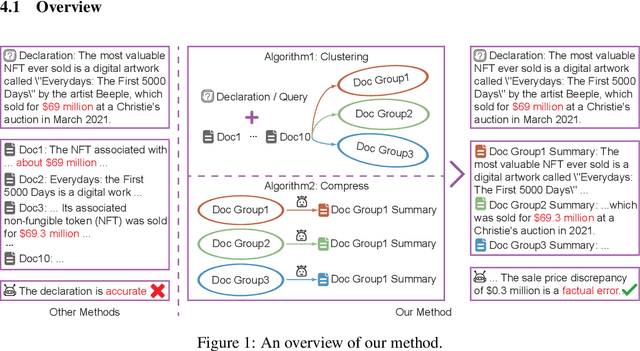
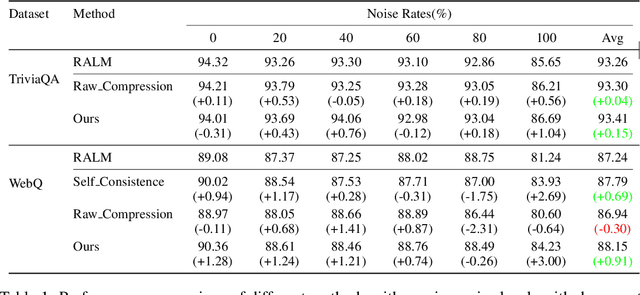
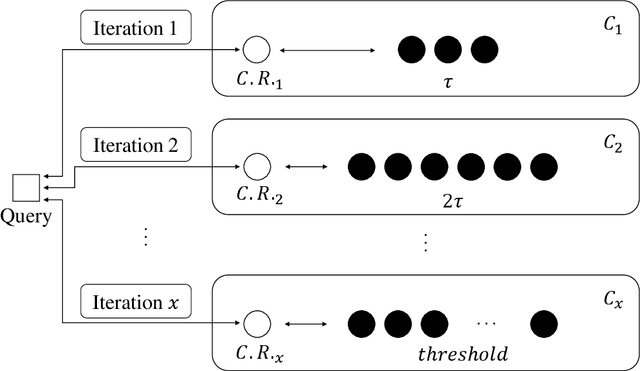
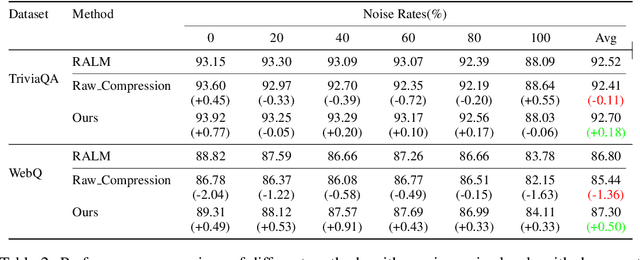
Retrieval-Augmented Generation (RAG) has emerged as a widely adopted approach for knowledge integration during large language model (LLM) inference in recent years. However, current RAG implementations face challenges in effectively addressing noise, repetition and redundancy in retrieved content, primarily due to their limited ability to exploit fine-grained inter-document relationships. To address these limitations, we propose an \textbf{E}fficient \textbf{D}ynamic \textbf{C}lustering-based document \textbf{C}ompression framework (\textbf{EDC\textsuperscript{2}-RAG}) that effectively utilizes latent inter-document relationships while simultaneously removing irrelevant information and redundant content. We validate our approach, built upon GPT-3.5, on widely used knowledge-QA and hallucination-detected datasets. The results show that this method achieves consistent performance improvements across various scenarios and experimental settings, demonstrating strong robustness and applicability. Our code and datasets can be found at https://github.com/Tsinghua-dhy/EDC-2-RAG.
EXIT: An EXplicit Interest Transfer Framework for Cross-Domain Recommendation
Jul 29, 2024Cross-domain recommendation has attracted substantial interest in industrial apps such as Meituan, which serves multiple business domains via knowledge transfer and meets the diverse interests of users. However, existing methods typically follow an implicit modeling paradigm that blends the knowledge from both the source and target domains, and design intricate network structures to share learned embeddings or patterns between domains to improve recommendation accuracy. Since the transfer of interest signals is unsupervised, these implicit paradigms often struggle with the negative transfer resulting from differences in service functions and presentation forms across different domains. In this paper, we propose a simple and effective EXplicit Interest Transfer framework named EXIT to address the stated challenge. Specifically, we propose a novel label combination approach that enables the model to directly learn beneficial source domain interests through supervised learning, while excluding inappropriate interest signals. Moreover, we introduce a scene selector network to model the interest transfer intensity under fine-grained scenes. Offline experiments conducted on the industrial production dataset and online A/B tests validate the superiority and effectiveness of our proposed framework. Without complex network structures or training processes, EXIT can be easily deployed in the industrial recommendation system. EXIT has been successfully deployed in the online homepage recommendation system of Meituan App, serving the main traffic.
Agent Hospital: A Simulacrum of Hospital with Evolvable Medical Agents
May 05, 2024
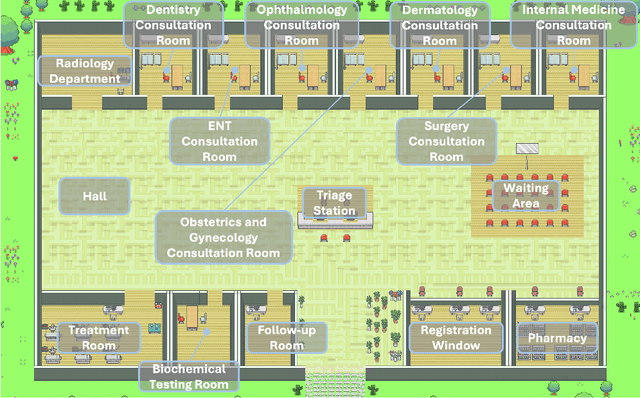
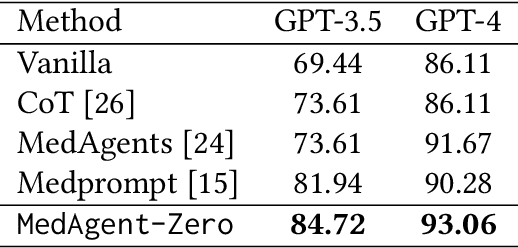
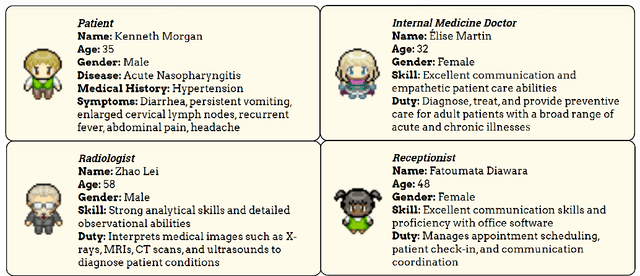
In this paper, we introduce a simulacrum of hospital called Agent Hospital that simulates the entire process of treating illness. All patients, nurses, and doctors are autonomous agents powered by large language models (LLMs). Our central goal is to enable a doctor agent to learn how to treat illness within the simulacrum. To do so, we propose a method called MedAgent-Zero. As the simulacrum can simulate disease onset and progression based on knowledge bases and LLMs, doctor agents can keep accumulating experience from both successful and unsuccessful cases. Simulation experiments show that the treatment performance of doctor agents consistently improves on various tasks. More interestingly, the knowledge the doctor agents have acquired in Agent Hospital is applicable to real-world medicare benchmarks. After treating around ten thousand patients (real-world doctors may take over two years), the evolved doctor agent achieves a state-of-the-art accuracy of 93.06% on a subset of the MedQA dataset that covers major respiratory diseases. This work paves the way for advancing the applications of LLM-powered agent techniques in medical scenarios.